


PORT LEVEL FEATURES
-
Interface category
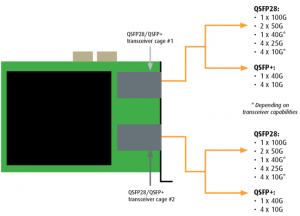
QSFP28: 100G, 50G, 40G*, 25G, and 10G* Ethernet
QSFP+: 40G and 10G Ethernet*Depending on transceiver capabilities
-
Number of test ports (software configurable)
2x100GE, 4x50GE, 2x50GE PAM4, 2x40GE, 8x25GE, and 8x10GE
-
Interface options
1 x 100GBASE-SR4/LR4/CR4 (as per 802.3bj), or
2 x 50GBASE-SR2/LR2/CR2 (as per Consortium**), or
1 x 50GBASE-SR/CR (PAM4) (as per 802.3cd), or
1 x 40GBASE-SR4/LR4/CR4 (as per 802.3ba), or
4 x 25GBASE-SR/LR/CR (as per 802.3by/Consortium**), or
4 x 10GBASE-SR/LR/CR (as per 802.3ae)Actual interface options depend on the capabilities of the inserted transceiver.
Both cages must run with the same base interface configuration (e.g. 2 x 100GE)
** As defined by Ethernet Technology Consortium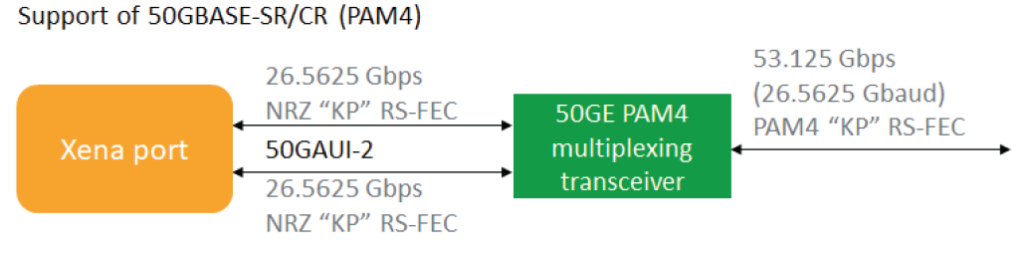
-
Forward Error Correction (FEC)
RS-FEC (Reed Solomon) 528,514,t=7, IEEE 802.3 Clause 91 (100GE)
RS-FEC (Reed Solomon) 544,514,t=15, IEEE 802.3 Clause 134 (50GE PAM4)
RS-FEC (Reed Solomon) 528,514,t=7, IEEE 802.3 Clause 108 (25GE)
RS-FEC (Reed Solomon) 528,514,t=7, 25/50G Ethernet Consortium (25/50GE)
BASE-R FEC (Firecode) 2112,2080 IEEE 802.3 Clause 74 (25GE, 10GE) -
Number of transceiver module cages
2 x QSFP28/QSFP+
-
Port statistics (2)
Link state, FCS errors, pause frames, ARP/PING, error injections, training packet
All traffic: RX and TX Mbit/s, packets/s, packets, bytes
Traffic w/o test payload: RX and TX Mbit/s, packets/s, packets, bytes -
Adjustable Inter Frame Gap (IFG)
Configurable from 16 to 56 bytes, default is 20B (12B IFG + 8B preamble)
-
Transmit line rate adjustment
Ability to adjust the effective line rate by forcing idle gaps equivalent to -1000 ppm (increments of 10 ppm)
-
Transmit line clock adjustment
From -400 to 400 ppm in steps of 0.001 ppm (shared across all ports)
-
ARP/PING
Supported (configurable IP and MAC address per port)
-
Field upgradeable
System is fully field upgradeable to product releases (FPGA images and Software)
-
Histogram statistics (2)
Two real-time histograms per port. Each histogram can measure one of RX/TX packet length, IFG, jitter, or latency distribution for all traffic, a specific stream, or a filter.
-
Tx disable
Enable/disable of optical laser or copper link
-
IGMPv2 multicast join/leave
IGMPv2 continuous multicast join, with configurable repeat interval
-
Loopback modes
• L1RX2TX – RX-to-TX, transmit byte-by-byte copy of the incoming packet
• L2RX2TX – RX-to-TX, swap source and destination MAC addresses (1)
• L3RX2TX – RX-to-TX, swap source and destination MAC addresses and IP addresses (1)
• TXON2RX – TX-to-RX, packet is also transmitted from the port
• TXOFF2RX – TX-to-RX, port’s transmitter is idle
• Port-to-port – Inline loop mode where all traffic is looped 100% transparent at L1 -
Oscillator characteristics
• Initial Accuracy is 3 ppm
• Frequency drift over 1st year: +/- 3 ppm (over 15 years: +/- 15 ppm)
• Temperature Stability: +/- 20 ppm (Total Stability is +/- 35 ppm)
100/50/40/25GE/10G PCS/PMA LAYERS
-
Payload Test Pattern
PRBS-31
-
Error Injection
Manual single shot bit-errors or bursts
-
PCS virtual lane configuration
User-defined skew insertion per Tx virtual lane, and user defined virtual lane to SerDes mapping for testing of the Rx PCS virtual lane re-order function.
-
PCS virtual lane statistics
Relative virtual lane skew measurement (up to 2048 bits)
-
FEC Total Statistics
NRZ: Total corrected FEC symbols, Total uncorrected FEC symbols, Estimated Pre-FEC BER, Estimated Post-FEC BER, Pre-FEC Error Distribution Graph
-
Link Flap
Single short or repeatable link down events with ms precision
-
Error Injection (PMA Layer)
Repeatable error inject periods at PMA layer with ms precision
TRANSMIT ENGINES
-
Number of transmit streams per port
256 (wire-speed) continuous. Each stream can generate millions of traffic flows through the use of field modifiers.
-
Test payload insertion per stream
Wire-speed packet generation with timestamps, sequence numbers, and data integrity signature optionally inserted into each packet.
-
Stream statistics (1)
TX Mbit/s, packets/s, packets, bytes, FCS error
-
Bandwidth profiles
Burst size and density can be specified. Uniform and bursty bandwidth profile streams can be interleaved
-
Field modifiers
16-bit or 32-bit header field modifiers with inc, dec, or random mode. Each modifier has configurable bit-mask, repetition, min, max, and step parameters. 8 16-bit modifiers per stream or 4 32-bit modifiers per stream.
-
Packet length controls
Fixed, random, butterfly, and incrementing packet length distributions. Packet length from 60 to 12288 bytes
-
Packet payloads
Repeated user specified 1 to 18B pattern, an 8-bit incrementing pattern
-
Extended payload
Fixed full custom payloads can be generated for each stream with payload sizes up to 12288 bytes
-
Error generation
Undersize length (60 bytes min. / at 10G 56 byte min.) and oversize length (12288 bytes max.) packet lengths, injection of sequence, misorder, payload integrity, and FCS errors
-
TX packet header support and RX autodecodes
Ethernet, Ethernet II, VLAN, ARP, IPv4, IPv6, UDP, TCP, LLC, SNAP, GTP, ICMP, RTP, RTCP, STP, MPLS, PBB, or fully specified by user
-
Pause Frames
Responds to incoming pause and PFC (Priority-based Flow Control) frames
-
Packet scheduling modes
• Normal (stream interleaved mode). Standard scheduling mode, precise rates, minor variation in packet inter-frame gap.
• Strict Uniform. New scheduling mode, with 100% uniform packet inter-frame gap, minor deviation from configured rates.
• Sequential packet scheduling (sequential stream scheduling). Streams are scheduled continuously in sequential order, with configurable number of packets per stream.
• Burst. Up to 10000 packets per stream are organized in bursts. Bursts from active streams form a burst group. The user specifies time from start of one burst group till start of next burst group
RECEIVE ENGINE
-
Number of traceable Rx streams per port
2016 (wire-speed)
-
Automatic detection of test payload for received packets
Real-time reporting of statistics and latency, loss, payload integrity, sequence error, and misorder error checking
-
Jitter measurement
Jitter (Packet Delay Variation) measurements compliant to MEF10 standard with 8 ns accuracy. Jitter can be measured on up to 32 streams.
-
Stream statistics (2)
• RX Mbit/s, packets/s, packets, bytes.
• Loss, payload integrity errors, sequence errors, misorder errors
• Min latency, max latency, average latency
• Min jitter, max jitter, average jitter -
Latency measurements accuracy
±16 ns (opto/elec).
-
Latency measurement resolution
8 ns (Latency measurements can calibrate and remove latency from transceiver modules)
-
Number of filters:
• 6 x 64-bit user-definable match-term patterns with mask, and offset
• 6 x frame length comparator terms (longer, shorter)
• 6 x user-defined filters expressed from AND/OR’ing of the match and length terms. -
Filter statistics (2)
Per filter: RX Mbit/s, packets/s, packets, bytes.
CAPTURE
-
Capture criteria
All traffic, stream, FCS errors, filter match, or traffic without test payloads
-
Capture start/stop triggers
Capture start and stop trigger: none, FCS error, filter match
-
Capture limit per packet
16 – 12288 bytes
-
Wire-speed capture buffer per port
256 kB for 100G
128 kB for 40G -
Low speed capture buffer per port (10Mbit/sec)
4096 packets (any size)
ADVANCED PHY FEATURES
-
Transmit Equalization Controls
– Tx Transmit Equalization Controls Pre-emphasis
– Tx Attenuation
– Tx Post-emphasis Signal Integrity Analysis Graphical “eye” diagram
– Rx Optional Auto-Tune of PHY 25Gbps Rx SerDes